
Support for industry placement mentors
8. Planning and running mentoring sessions
Time with your student is the heart of the matter for you as a mentor. It’s when all the preparation and planning pay off. It’s also where your personal qualities come into play as mentoring is above all a relationship. There are important things you can do to make the sessions go well. But at the end of the day it’s for you and your student, between you, to make it work.
This module will cover how to
Be inside the mentoring mindset
—
Prepare the ground
—
Get into the zone
—
Plan a session
—
Run the session
—
Tackle problems
Be inside the mentoring mindset
Good mentors occupy a special mindset. Everything else they have had to do, and everyone they have been during the rest of the day, are put to one side when they are in a mentoring session.
The mentoring mindset is a mixture of:
- Curiosity – mentors think that people are the experts on their own lives, so the mentoring mindset is curious to learn about what makes students tick. They ask questions and don’t make assumptions
- Humility – mentors know they still have much to learn themselves so they’re not on any kind of a pedestal
- Respect – they know they can have a good mentoring relationship with someone who is quite different in many ways, and these differences don’t make students wrong or deficient in any way
When mentors think about the kind of mentor they want to be, it helps them to bring compassion, empathy and a good dose of listening to the relationship
Company director and experienced mentor
Prepare the ground
When you’ve agreed to mentor a student, it’s time to work out the practical details of when you’ll have contact with them, how often, where and how. You only need to do this once at the start, but be flexible – ground rules can be altered by agreement at any time.
When
Agree which day of the week and which time of day works best for you and the student. It might be good to set a regular day and time so there’s a pattern. Or you could choose to keep it flexible.
How often
It’s good practice to have a clear idea about how often mentoring sessions will take place. With industry placements it depends on which model is used – day release, block release or a mixed approach. Agree the outline with your student at least even if you don’t set a firm timetable e.g. a one-hour mentoring session each month plus a shorter call in-between.
How long
Mentoring sessions can last anything from 15 minutes to two hours, depending on their purpose. Some students prefer shorter, more frequent sessions while others like to meet less often but go into more depth. It may be prudent to plan some contingency time in, just in case the sessions over-run.
Where
If you’re meeting face to face, book a room or go to a quiet place where you can talk openly and won’t be interrupted. There’s no need to go outside the normal workplace. Meeting at work may be the best option for shorter, informal sessions anyway. The environment needs to be comfortable for you both.
How
Face to face mentoring is good for creating rapport and getting to know each other. All the communication cues, verbal and non-verbal, are there. It’s sometimes logistically easier to mentor the student online or on the phone once a relationship is in place. Some people find virtual or remote contact easier in other ways as well.
Consider
What practical steps could you take to make remote mentoring work well?
Here are some ideas
Suggestions from an experienced mentor:
Planning
- Schedule it in advance – no ‘I’m too busy right now’ excuses
- Keep up the momentum – weekly calls are good, even if they’re short
- Use video calls where possible – they give a stronger sense of contact than audio only
- Arrange for you both to be in an environment where a call can be made conveniently without interruption
Preparing
- Agree what you’re going to cover in advance – put the topics in an email
- Ask the student to put their thoughts down before the call and send them by email – it helps them to prepare and allows you to go deeper on the call
- Stay focused – treat it like a business call
Get into the mentoring zone
Mentoring an industry placement student is probably a small part of your job so there’s a danger it gets tagged on.
Here’s how to do it justice:
- Give the role due care and consideration – carve out time to think about where your student is at, what they need and how you can support them
- Treat it as an investment you’re making in another person’s development, on behalf of your organisation – today’s students make up the new entrants in tomorrow’s workforce
- Put the student at the front of your mind – your role as a mentor is to support them first and foremost
- Prepare yourself for a different way of working, especially if your job normally involves supervising or leading – you’re not in control of the agenda or the solutions, both are discussed and agreed with the student in an equal partnership
- Look forward to it – mentoring often provides great learning and job satisfaction to the mentor
You end up looking at things a bit differently as a result of having the student here and because, on the whole, they are really engaged young people, who do actually bring something by way of enthusiasm and willingness
Mentor in a creative design studio
If nobody gives a sixteen-year-old a chance, then how can they ever get the experience to move on, so the philosophy is basically giving them a chance and doing what we can
Owner-manager of a local childcare provider
Consider
How can you get yourself into the zone? Think of five or six questions to ask yourself while preparing for a mentoring session with your placement student.
Here are some ideas
Here are a few questions you might find useful:
- Which of the student’s learning goals should we focus on?
- What was agreed at the last session?
(Look back at action logs or learning plans to remind yourself) - How did we get on at the last session – is there anything to build on this time?
- Which questions should you be asking of the student at this stage?
- What are we going to focus on and what does that require you and the student to do in advance?
- How and where are we going to meet?
- Who’s going to take the lead at the start, you or the student?
Plan the session
Mentoring is a journey, with different route plans and pathways for each student. But regardless of what’s covered in each mentoring session it’s good to have a structure in mind to take care of the basics. Here’s an example of a quick reminder note to keep the session focused – a bit like an agenda but less formal.
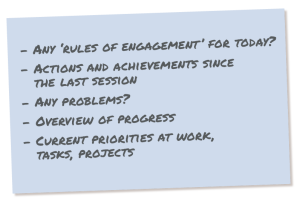
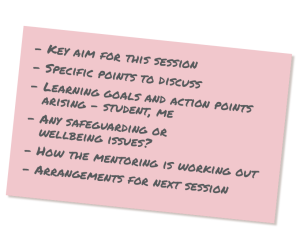
Run the session
Your job is to keep the session focused while continuing to build trust, rapport and a productive working relationship with your student. You’ve planned how to use the time, now it’s all about your behaviours at each moment. Here are some pointers.
- Create an environment of trust by being open and honest
- Help the student to reflect by identifying situations, problems or challenges they’ve come up against
- Take your lead from the student, while not letting the session get diverted from its purpose
- Ask questions and listen properly to the answers
- Bring in your knowledge and expertise as a confident and skilled practitioner, but do it lightly not overbearingly
- Enable the student to create options which they are comfortable with (and so are more likely to act on)
- Use your analytical powers to pinpoint actions which you think will be most successful and motivating
- Take care to develop the student’s own analytical and problem-solving skills

You and the student could use a technique such as the GROW model to keep the session focused:
G Be clear about the GOAL for this session
R Concentrate on the REALITIES of the situation the student is in right now
O Consider the potential OPTIONS available
W Agree the WAY forward and commit to it
Tackle problems
Mentoring isn’t always easy and it sometimes goes wrong.
If there are signs that things aren’t working out, talk openly about them with your student. Try to resolve the problem together. Is it about things like attendance, timekeeping or attitude? Are you more anxious about slow progress than your student? Do you rub each other up the wrong way?
Some problems can be sorted out quite quickly once they’re in the open. If you’re more worried about progress than your student, have a conversation about whether the pace is right for them. It might be an easy solution to adjust the goals. If there’s a glitch with the mentoring arrangements, it’s in both your powers to decide a different approach.
There may be a more fundamental problem. Uncovering it might take patience, steadiness and balance. You might need to exercise a lot of your emotional intelligence. At some point you’ll both need to assess whether the relationship has broken down beyond repair or just needs resetting in some way. You may need to take the lead in getting to this point, without damaging your student’s confidence or powers.
If the relationship can be reset, it’s probably worth going back to the drawing board. Agree roles, responsibilities, ways of working again from scratch. Try to build in ways of stopping the problems coming back.
If you both think that the relationship shouldn’t continue, it’s your job to manage the situation professionally and close it down carefully and sensitively. If possible, have a final session together to agree what’s been achieved and how to take the next steps. You may be able to help the student identify a new mentor, or you might feel you’re better handing over to someone else to do this.
Prevention is also better than cure. Talk about how you’re each feeling at the end of a session. Ask for and accept feedback. Offer your own perspective of how the arrangements are working, whether the time together is valuable and if there are any changes which would be beneficial. How will you both work to ensure that the relationship will continue to be useful?
Summary
During this section you have covered how to:
Be inside the mentoring mindset
—
Prepare the ground
—
Get into the zone
—
Plan a session
—
Run the session
—
Tackle problems
Complete your action plan to put your learning into practice: